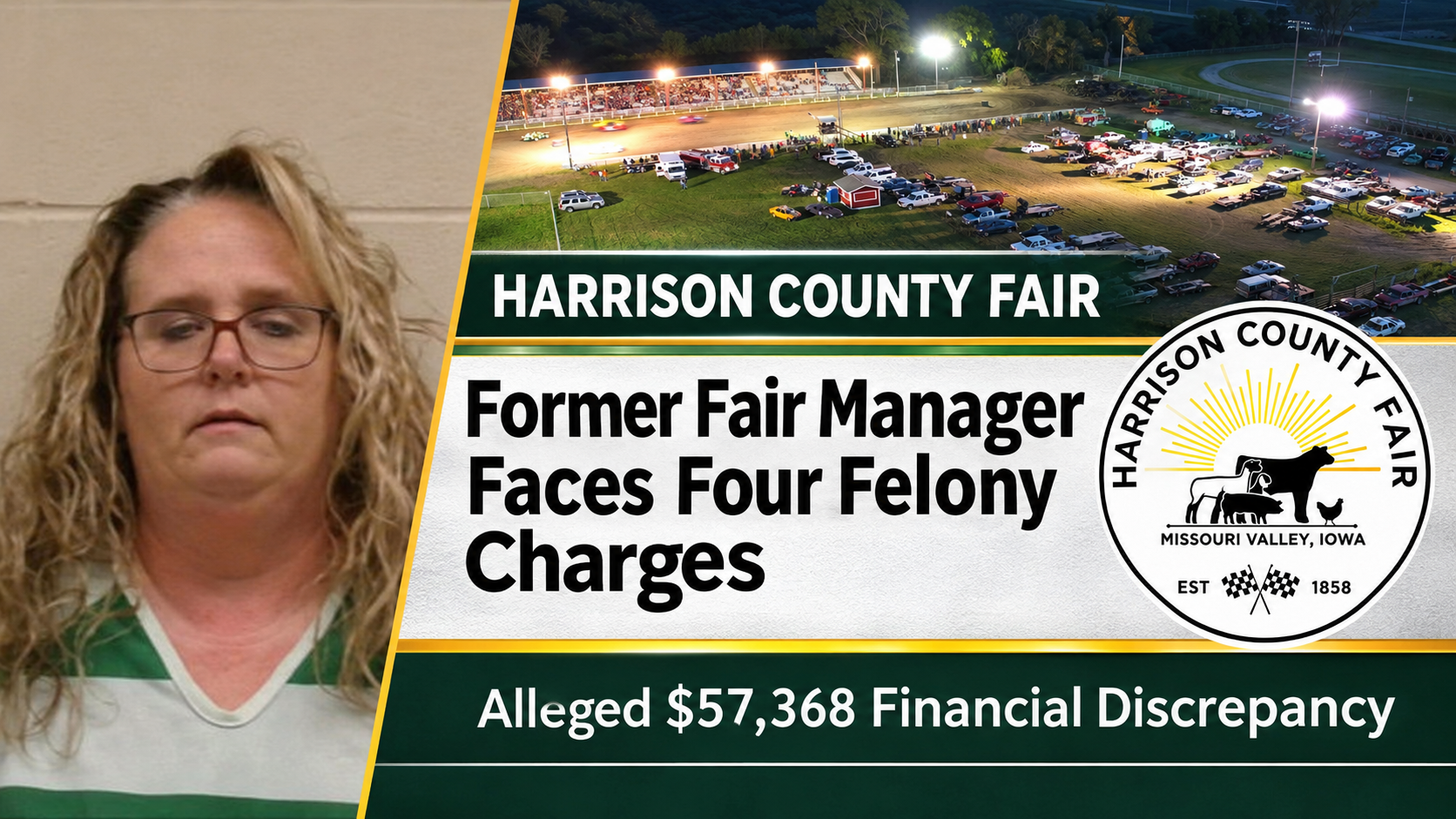

Court documents allege funds were diverted to a privately owned business and financial records were manipulated. The investigation raises questions about financial oversight at a publicly supported nonprofit that has served Harrison County for generations.
MISSOURI VALLEY, Iowa — Former Harrison County Fair Manager Trista Marie McLaughlin, 52, of Missouri Valley, is facing four felony charges following an Iowa Division of Criminal Investigation (DCI) investigation into the alleged misappropriation of funds belonging to the Harrison County Fair Board.
Criminal complaints filed in Harrison County District Court on November 12, 2026, allege that McLaughlin transferred tens of thousands of dollars from the organization’s bank account to her own business and intentionally concealed transactions from financial records presented to the Fair Board. Investigators identified a total financial discrepancy of $57,368.27, including $40,647.52 in checks allegedly written to McLaughlin Septic and an additional $16,720.75 believed to be missing cash. McLaughlin has since bonded out of jail on a $55,000 surety bond and is scheduled to make her initial court appearance on November 30, 2026. The allegations involve an organization that has served generations of Harrison County residents and receives financial support from local families, businesses, community organizations and both county and state governments.
McLaughlin Septic Owner Denies Prior Knowledge, Offers Apology to Fair Community
In a November 19 response to Missouri Valley Voices, Ryan McLaughlin, owner of McLaughlin Septic and husband of Trista McLaughlin, confirmed that his business had performed work for the Harrison County Fair Board but stated that the value of that work was nowhere near the approximately $40,000 identified in the criminal complaints.
“Unfortunately I was not aware of the 2 payments,” McLaughlin wrote.
McLaughlin said he had learned of the situation less than 24 hours before responding to Missouri Valley Voices and after his wife had already been taken into custody and released. He stated that he had not been responsible for managing the financial side of McLaughlin Septic prior to November 19, 2026, and indicated that he was now assuming those responsibilities.
“Im as surprised about this as everyone else,” he wrote.
McLaughlin also offered an apology to 4-H, the children and the Harrison County Fair Board.
Some Funds May Have Already Been Repaid
McLaughlin also disclosed that, to his knowledge, approximately half or potentially more of the money may have already been repaid. “I believe better than half or close to has been paid back to my knowledge. But I am still gathering more by the minute,” McLaughlin wrote. The amount, timing and source of any repayments have not been independently verified. It also remains unclear whether McLaughlin was referring to the two payments totaling $40,647.52 or the broader financial discrepancy of $57,368.27 identified by investigators. Confirmation of any repayment would provide important context regarding the Fair Board’s actual outstanding financial loss and its current financial position. His statements represent his account of the circumstances. Ryan McLaughlin is not named as a defendant in the criminal complaints reviewed by Missouri Valley Voices. The criminal charges against Trista McLaughlin remain pending, and she is presumed innocent unless and until proven guilty in court.
A Community Institution Dating Back to 1858
For 168 years, the Harrison County Fair has been part of the county’s agricultural heritage and community identity. Operated through a nonprofit association, the fair provides opportunities for agricultural education, youth development, livestock exhibitions, local businesses, community recreation and the celebration of local talent. For many Harrison County families, the annual fair represents far more than several days of entertainment. Children participating in 4-H and FFA spend months raising livestock, preparing exhibits and developing projects that are ultimately showcased at the fair. These programs provide opportunities for young people to develop leadership, responsibility, financial management, public speaking and practical agricultural skills. The fair also provides opportunities for residents of all ages to participate in open-class competitions, including livestock exhibitions, culinary arts, horticulture, photography, arts and crafts. Beyond the annual fair, the organization hosts other events, including Figure 8 races, and maintains facilities used for agricultural and community activities.
According to the Harrison County Fair Association’s published 2025 annual financial report, the fair reported:
- An estimated attendance of 10,000.
- 807 livestock and non-livestock exhibits through 4-H and FFA.
- 576 open-class exhibits.
- A combined total of 1,383 exhibits.
- $3,378 in cash awards for 4-H and FFA participants.
- $1,083 in cash awards for open-class participants.
General admission to the fairgrounds was free, although admission to grandstand events was paid. The organization also relies on the support of volunteers, sponsors and local businesses to sustain its activities. The financial resources entrusted to the Fair Board support an institution that serves residents across Harrison County, including children, agricultural families and visitors from surrounding communities.
Sources: Harrison County Fair Official Website | About the Harrison County Fair | 2026 Fair Book
The Harrison County Fair Association and Its Leadership
The Harrison County Fair Association is a nonprofit corporation. Business registration records identify the organization under Iowa entity number 58464, with an incorporation date of June 10, 1976. The organization’s formal incorporation occurred more than a century after the establishment of the fair itself.Federal nonprofit tax records also identify the Harrison County Agriculture Society, a Missouri Valley-based 501(c)(3) organization established in 1936 whose stated activities include operating the Harrison County Fair, promoting agricultural development and providing educational and recreational opportunities. The precise legal relationship between the two organizational names requires further examination of their incorporation documents and governing records.
The Fair Board’s official website identifies the following officers:
- Riley Kurth — President
- Shelby Martens — Vice President
- Chris Higgins — Treasurer
The fair manager position is listed without an individual identified on the website.
The following individuals are listed as directors:
| Director | Community |
|---|---|
| John Bertelsen | Missouri Valley |
| Garth Brown | Missouri Valley |
| Tim Faylor | Missouri Valley |
| Bryant Hatcher | Pisgah |
| Riley Kurth | Missouri Valley |
| Shelby Martens | Missouri Valley |
| Lou Phillips | Missouri Valley |
| Chris Higgins | Mondamin |
| Catie Faylor | Mondamin |
| Austin Fox | Missouri Valley |
| Christina Niziol | Logan |
| Arron Olson | Missouri Valley |
| Tim Dragt | Missouri Valley |
Associate directors include Art Keller, Bud Dooley and Chad Porter, all of Missouri Valley. Carter Oliver is identified separately as the Harrison County Extension and Outreach Director and 4-H contact. The roster reflects the organization’s publicly listed leadership and does not necessarily establish who served in each position throughout the period identified in the criminal complaints. The criminal complaints reviewed for this article contain charges against McLaughlin. They do not accuse the other listed directors or officers of participating in the alleged criminal activity.
Sources: Official Fair Board Directory | Iowa Business Registration Listing | Federal Nonprofit Tax Records — ProPublica
Where Does the Fair Board Get Its Money?
Although the Harrison County Fair Association operates as a nonprofit organization, its activities are supported in part by taxpayer-funded appropriations. The association’s annual financial report for the fiscal year beginning October 1, 2024, and ending September 30, 2025, identifies $216,447.68 in total receipts.
Those funds came from several sources.
| Revenue source | Amount |
|---|---|
| Fair-related income | $138,999.90 |
| Non-fair income | $31,900.00 |
| Harrison County funding | $24,500.00 |
| State funding | $10,322.78 |
| Grants | $10,725.00 |
| Total receipts | $216,447.68 |
Combined county and state funding amounted to $34,822.78, representing approximately 16.1% of the organization’s reported annual receipts. That percentage does not include any public funding that may have been included within the separately reported grant category. The remainder of the organization’s receipts consisted primarily of fair-related activities, non-fair income and grants.
The same financial report identified the following expenditures:
| Expenditure | Amount |
|---|---|
| Fair expenses | $129,200.61 |
| Non-fair expenses | $25,816.98 |
| Capital improvements | $25,816.98 |
| Debt payments | $8,997.00 |
| Total expenses | $189,831.57 |
The association reported beginning the fiscal year with a cash balance of $25,350.49 and ending the year with $51,966.60. After accounting for $13,860 in outstanding debt, the organization reported a net ending cash position of $38,106.60. These figures are particularly relevant because the reporting period includes the date of the first allegedly improper transaction identified by investigators. The figures represent what the association publicly reported and have not been independently reconciled against its underlying bank records for this article.
Source: Harrison County Fair Association FY2025 Annual Financial Report
Financial Responsibilities of the Former Fair Manager
According to sworn affidavits filed by DCI investigator David Hendrix, McLaughlin served as the Harrison County Fair Manager from November 2022 through August 3, 2026. As fair manager, McLaughlin was responsible for managing the organization’s bank accounts, writing checks, making deposits, withdrawing funds and maintaining financial records through QuickBooks. Investigators stated that McLaughlin provided copies of the QuickBooks register to the Fair Board during its monthly meetings. According to the affidavits, the Fair Board relied on McLaughlin to provide accurate information regarding the organization’s financial position. However, investigators allege that transactions were intentionally omitted from the records provided to the Board beginning in April 2025. McLaughlin was also identified as the association’s secretary in its 2025 annual financial report. The combination of these responsibilities raises questions about how the organization’s financial information was independently reviewed, who had access to original bank statements and whether safeguards existed to prevent unauthorized transactions.
Two Checks Allegedly Issued to McLaughlin’s Own Business
According to the criminal complaints, the Fair Board first noticed a discrepancy in its bank account in April 2026. Investigators subsequently identified two checks allegedly written by McLaughlin from the Fair Board’s bank account to McLaughlin Septic, a business identified in the affidavits as belonging to McLaughlin. The first check was dated April 1, 2025, in the amount of $29,542.40. The second check was dated March 3, 2026, in the amount of $11,105.12. Together, the checks totaled $40,647.52. According to the affidavits, the Fair Board could not identify a legitimate reason for payments of those amounts to McLaughlin Septic. Investigators allege that both checks were deposited into a McLaughlin Septic account and that the funds were subsequently distributed into other accounts belonging to McLaughlin.
Investigators further allege that neither check was entered into the QuickBooks records presented to the Fair Board, concealing the transactions from the organization’s financial reports. The first questioned transaction occurred approximately one year before the Fair Board reportedly discovered a financial discrepancy.
Additional $16,720.75 Believed to Be Missing Cash
According to investigators, the financial discrepancies extended beyond the two checks. At the end of June 2026, McLaughlin reportedly presented the Fair Board with a bank balance of $113,479.06. However, the corresponding statement directly from American National Bank reflected an actual balance of $56,110.79. The difference between the two balances was $57,368.27.
| Identified financial discrepancies | Amount |
|---|---|
| Check dated April 1, 2025 | $29,542.40 |
| Check dated March 3, 2026 | $11,105.12 |
| Additional suspected missing cash | $16,720.75 |
| Total discrepancy | $57,368.27 |
Investigators believe the remaining $16,720.75 represents missing cash. The affidavits explain that the organization handles a substantial amount of cash because many of its events charge cash admission fees. McLaughlin was responsible for depositing and withdrawing those funds. Investigators allege that the omission of the two checks resulted in inaccurate financial statements being presented to the Fair Board beginning in April 2025. The two checks are the subject of separate first-degree theft complaints. The additional suspected missing cash is described in the broader investigative affidavits.
Source: Iowa Division of Criminal Investigation criminal complaints and sworn affidavits, filed November 12, 2026, Harrison County District Court, case FECR015374. Public docket information is available through Iowa Courts Online.
Annual Financial Report Signed During Period of Alleged Misconduct
The Harrison County Fair Association’s 2025 annual financial report provides another significant piece of the financial timeline. The report, which carries a November 12, 2025, publication notation, identifies the following officers as having signed the report:
- Riley Kurth, President.
- Trista McLaughlin, Secretary.
- Chris Higgins, Treasurer.
The reporting period ended September 30, 2025, approximately six months after the first check identified in the criminal complaints. The report also includes a sworn declaration concerning cash awards paid to fair participants and the use of state appropriations for infrastructure. The existence of the report raises questions regarding what documentation was used to verify the organization’s financial position and whether the reported figures were reconciled with original bank statements.
The criminal complaints do not establish whether the president or treasurer knew about the questioned transactions when the financial report was signed. It also remains unknown whether the association has submitted amended financial reports following the discovery of the alleged discrepancies.
Source: 2025 Annual Financial Report and Premiums Paid Affidavit
Iowa Law Establishes Requirements for Public Funding
The organization’s receipt of county and state funding carries additional financial reporting requirements under Iowa law. Under Iowa Code Section 174.19, a fair receiving county appropriations must submit a financial statement to the county Board of Supervisors accounting for the prior year’s county-funded expenditures, accompanied by supporting vouchers, before receiving further appropriations under the chapter.
This means financial reporting is not solely an internal matter between the Fair Board and its management. Iowa law also establishes a reporting obligation associated with the receipt of county funding. State appropriations are subject to separate requirements. Under Iowa Code Section 174.9, eligible fairs must provide annual financial and statistical information to the Association of Iowa Fairs to qualify for state aid. State aid is restricted to qualifying capital expenditures involving fairgrounds property and improvements. It cannot be used for ordinary operating expenses, payroll, entertainment or other prohibited expenditures.
Under Section 174.10, the Association of Iowa Fairs distributes state funding to eligible fairs and must report to the governor and Iowa General Assembly regarding the allocation and expenditure of those funds. The Harrison County Fair Association’s 2025 financial report declares that its state appropriations were used exclusively for infrastructure. The criminal complaints do not establish whether any county or state appropriations were among the allegedly misappropriated funds. Determining whether taxpayer dollars were affected would require reviewing the organization’s underlying bank records, expenditure vouchers, financial reconciliations and documentation submitted to county and state authorities.
Sources: Iowa Code §174.19 — Report of County Aid | Iowa Code Chapter 174 — County and District Fairs | Iowa Code §174.10 — State Appropriations
The Financial Significance of the Allegedly Missing Funds
For an organization reporting approximately $216,000 in annual receipts, a financial discrepancy exceeding $57,000 is substantial. Using the association’s published 2025 annual financial report as a point of comparison, the $57,368.27 discrepancy identified by investigators is equivalent to:
- 26.5% of the association’s annual receipts.
- 30.2% of its annual expenditures.
- 151% of its reported net year-end cash position.
- 234% of its annual Harrison County appropriation.
- 165% of its combined county and state funding.
- 222% of its annual capital improvement expenditures.
- Nearly 13 years of cash competition awards at the 2025 spending level.
The amount exceeds the organization’s entire reported cash balance at the end of its 2025 fiscal year. These comparisons illustrate the scale of the alleged financial discrepancies. They do not establish that these particular categories of funding were affected, and the alleged activity spans more than one fiscal year. For a nonprofit organization responsible for maintaining fairgrounds, financing annual events and supporting community activities, financial reserves can be particularly important.
Those resources could otherwise support livestock barns, exhibition facilities, electrical improvements, sanitation infrastructure, accessibility improvements, equipment maintenance, youth activities and educational opportunities. The loss of financial resources could also affect an organization’s ability to absorb unforeseen expenses without seeking additional donations, grants or taxpayer support. Whether the Harrison County Fair Association has postponed projects, reduced services, incurred additional debt or experienced other operational consequences as a result of the alleged financial misconduct remains unknown.
Previous Financial Records Reflect the Importance of Maintaining Reserves
Federal nonprofit tax records available through ProPublica’s Nonprofit Explorer show that the Harrison County Agriculture Society reported the following financial results for its fiscal year ending September 2024:
| Financial category | Amount |
|---|---|
| Total revenue | $191,314 |
| Total expenses | $215,125 |
| Annual deficit | $23,811 |
| Total assets | $483,871 |
| Total liabilities | $24,521 |
| Net assets | $459,350 |
The reported deficit predates the period of alleged criminal activity identified in the criminal complaints and does not constitute evidence of earlier misconduct. However, the figures demonstrate that the organization has previously reported expenditures exceeding annual revenue, reinforcing the importance of maintaining adequate reserves and reliable financial records. Total assets and net assets should not be confused with available cash, as these figures may include property, buildings, equipment and other non-liquid assets.
Source: Harrison County Agriculture Society — IRS Form 990 Records
Four Felony Charges Filed
McLaughlin faces four felony charges in Harrison County District Court.
| Charge | Iowa Code | Classification |
|---|---|---|
| Ongoing criminal conduct — unlawful activity | 706A.2(4) | Class B felony |
| First-degree theft | 714.2(1) | Class C felony |
| First-degree fraudulent practice | 714.9 | Class C felony |
| First-degree theft | 714.2(1) | Class C felony |
The ongoing criminal conduct complaint alleges that McLaughlin engaged in multiple thefts for financial gain on a continuing basis. The two first-degree theft charges correspond to the individual checks allegedly written to McLaughlin Septic. The first-degree fraudulent practice complaint alleges that McLaughlin knowingly falsified or altered business records involving an amount exceeding $10,000.
Under Iowa Code Section 902.9, a Class B felony generally carries a maximum prison sentence of 25 years. Each Class C felony generally carries a maximum prison sentence of 10 years and a statutory fine ranging from $1,370 to $13,660 for a person who is not an habitual offender. If convicted on all four charges and if all individual maximum prison sentences could lawfully be imposed consecutively, the combined maximum would be 55 years. That figure represents a theoretical aggregate maximum and is not a prediction of the sentence McLaughlin would receive if convicted. Actual penalties would depend on the resolution of the charges and applicable sentencing law.
Source: Iowa Code §902.9 — Maximum Sentences for Felonies
Arrest Warrant, Release From Jail and Upcoming Court Appearance
On November 13, 2026, the court reviewed the criminal complaints and supporting affidavits, determined that probable cause existed and ordered an arrest warrant to be issued. Bond was set at $55,000, cash or surety. A return-of-service document was filed with the Harrison County Clerk of District Court on November 17 at 5:57 p.m. On November 18, at 10:27 a.m., the court issued an order confirming that McLaughlin had bonded out of jail and continued her initial appearance. Surety bond documentation was subsequently filed at 3 p.m., identifying Gallagher Bail Bonds LLC and Lexington National Insurance Corporation.
McLaughlin’s initial court appearance is scheduled for:
Monday, November 30, 2026, at 9:30 a.m.
Harrison County Courthouse
Logan, Iowa
Case number: FECR015374.


Timeline of Events
| Date | Event |
|---|---|
| November 2022 | McLaughlin begins employment as Harrison County Fair Manager. |
| April 1, 2025 | First allegedly improper check issued to McLaughlin Septic for $29,542.40. |
| July 23–27, 2025 | Harrison County Fair takes place. |
| September 30, 2025 | Association’s fiscal year ends. |
| November 12, 2025 | Publication date noted on the association’s annual financial report. |
| March 3, 2026 | Second allegedly improper check issued for $11,105.12. |
| April 2026 | Fair Board reportedly discovers a financial discrepancy. |
| June 30, 2026 | Reported and actual bank balances differ by $57,368.27. |
| August 3, 2026 | McLaughlin’s employment as fair manager ends. |
| November 12, 2026 | Four felony complaints filed. |
| November 13, 2026 | Court finds probable cause and orders arrest warrant. Bond set at $55,000. |
| November 17, 2026 | Return-of-service document filed. |
| November 18, 2026 | Court confirms McLaughlin has bonded out of jail. |
| November 30, 2026 | Scheduled initial court appearance. |
Questions Remain Regarding Financial Oversight
While the criminal complaints focus on the alleged conduct of the former fair manager, they leave unanswered questions regarding the organization’s financial oversight. In particular, the affidavits indicate that McLaughlin was responsible for handling cash, writing checks, managing bank transactions, maintaining financial records and presenting those records to the Board. Whether those responsibilities were subject to independent review or verification remains unclear.
Among the questions raised by the available records are:
- Who was responsible for independently reviewing the organization’s original bank statements?
- Were bank statements reconciled monthly with the QuickBooks records?
- Did the treasurer and other designated officers have independent access to the organization’s bank accounts?
- Were large payments subject to approval by multiple officers or directors?
- Did the organization maintain a conflict-of-interest policy regarding payments to businesses owned by employees or officers?
- How was the 2025 annual financial report prepared and verified?
- When were law enforcement authorities notified following the discovery of the discrepancies in April 2026?
- What occurred between the discovery of the discrepancy in April and the conclusion of McLaughlin’s employment in August?
- Has an independent audit been conducted covering McLaughlin’s entire tenure?
- Have additional financial discrepancies been identified?
- Were county appropriations, state funds, grants or other restricted funds affected?
- What financial documentation was submitted to the Harrison County Board of Supervisors?
- Did county or state funding continue following the discovery of the discrepancies?
- Has the association notified its insurance carrier or pursued recovery of the funds?
- What changes have been made to the organization’s financial controls?
- Will the financial discrepancies affect future fair operations, admission costs, youth activities or facility improvements?
The available criminal complaints do not establish wrongdoing by other Fair Board members. These questions concern the organization’s financial safeguards and the protection of resources entrusted to it.
Protecting a Community Institution
The Harrison County Fair has served generations of local families. Its continued operation depends not only on ticket sales and event revenue, but also on the contributions of volunteers, local businesses, sponsors, community organizations and taxpayers. Parents invest time and resources into their children’s 4-H and FFA projects. Businesses provide sponsorships. Volunteers contribute their time to preparing facilities and operating events. Taxpayers help finance the organization’s activities and infrastructure through county and state appropriations. The financial resources entrusted to the Fair Board represent a collective investment in the community.
For that reason, the implications of the alleged financial misconduct extend beyond the criminal proceedings against one individual. Understanding how the financial discrepancies occurred, what safeguards were in place, whether funds can be recovered and what steps are being taken to prevent future losses is important to protecting the community’s investment in the Harrison County Fair. The questions surrounding financial oversight are also important to preserving public confidence in an institution that has served Harrison County since 1858. The court documents reviewed for this article do not include a response from McLaughlin or her legal counsel, a formal response from the Fair Board, or an independent audit establishing the full extent of the financial discrepancies.
McLaughlin is presumed innocent unless and until proven guilty in a court of law.
Leave a Reply